T-Scann 8 - project page
Super 8 / Regular 8 film scanner
Arduino to card Controll T-Scann 8 V1.50
With change of white led to UV led 390-395 nm.
The reading of film perforation is significantly improved.
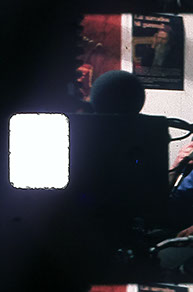
If all the films were completely black around the hole, it was no problem, but that is rarely the case.
The shorter the wavelength of the light, the more sensitive it becomes if something gets in the way, film has polyester as a base.
With accurate calibration it is possible to calibrate absolutely transparent film, the example shown here is washed film the film layer is dissolved with
caustic soda (normally used for sewage treatment). Normally, the film has some thin film left.
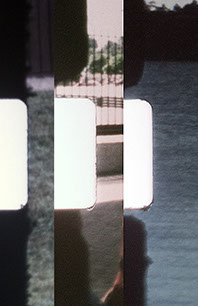
Super 8 example
Fig 1
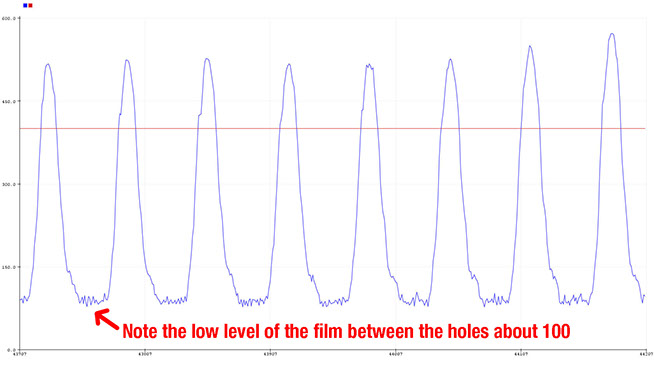
In version 1.5, the detection method has changed.
Fig. 1
The detection level is normally 400
53. int perfLevel = 400; // detector pulse level
Fig. 2
If it becomes very bright between the perforation holes, the level changes to 600
54. int Hlevel = 600; // detector pulse high level, clear film and low contrast film perforation
The line in the code that sets this is
291. if (measureP> = Level) {
perfLevel = Level;
}
When the movie then looks normal, this line changes back to the normal level 400. 295. else if (measureP <200) {
perfLevel = perfLevelOrg;
}
Fig. 3
The detection is filtered with these lines
287. if (measureP> = perfLevel) {
wave = measureP;
}
299. if (measureP <perfLevel) {
wave = 0;
}
These lines are very helpful in calibrating levels
// can be read in Arduino IDE "Serial plotter" Serial.println (wave)
// "wave" is filtered curve, change to "measureuP" and you will see the real curve
361. if (Play == HIGH) {
Serial.println (wave); Serial.print (","); Serial.println (perfLevel);
}
New in the version 1.5 is also that important settings are gathered in one place.
49. // ----- Important setting, may need to be adjusted ------
int Wled = 240; // Brightness UV led, may need to be changed depending on LED
int sped = 700; // speed stepper scan Play
int Ssped = 4000; // sped Rewind movie
int perfLevel = 400; // detector pulse level
int Hlevel = 600; // detector pulse high level, clear film and low contrast film perforation
int WstepV = 150; // Minimum number of steps, before new frame is exposed 150
I use this UV led, from a Swedish online store. Have asked for more technical data, but they do not know more I think this link is about 1000 mcd, it's more so do it.
UV led (UVA)
5mm
390-395 nm
1000 mcd about
NOTE - on controller card remove resistor R7, and jumper over it with a cable, otherwise the UV joint gets too little current
Fig 2
Fig 3
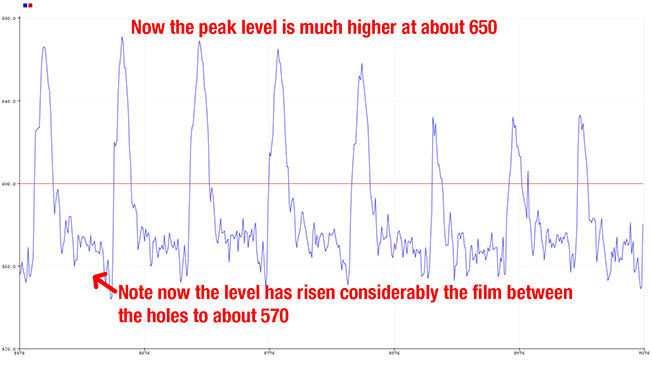
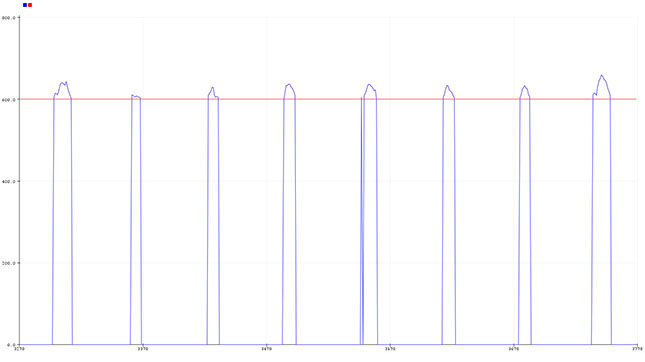
Arduino IDE has a function under Tools - Serial Plotter - which makes it possible to see the detection of
film perforation in real time.